Micromobility Operations#
The micromobility operations module in POLARIS models the supply-side management of shared micromobility services such as dockless e-scooter and shared bicycle systems. While the E-Scooter Adoption Choice model determines individual-level adoption propensity, this module manages the fleet operations that govern vehicle availability, spatial distribution, and repositioning.
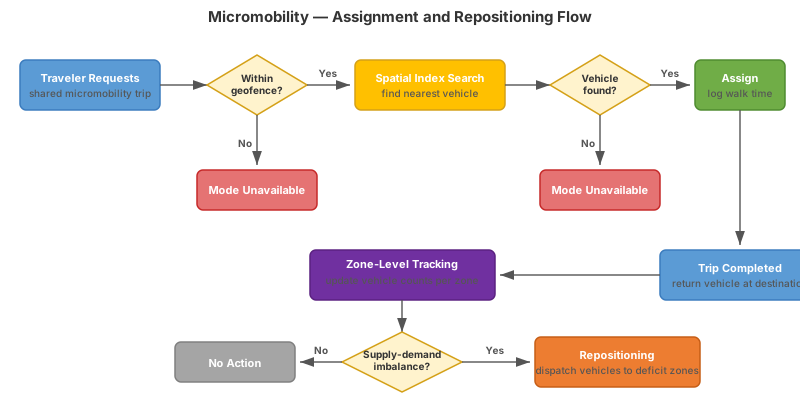
The figure below illustrates the end-to-end flow of a micromobility trip — from the traveler’s request, through geofence and availability checks, to assignment, trip completion, and periodic fleet repositioning.
Agency and Fleet Structure#
Each micromobility service is managed by a Micromobility Agency agent that owns and operates a fleet of shared vehicles. The agency is characterized by:
Fleet size: Total number of shared vehicles (e.g., e-scooters) deployed in the network.
Search radius: Maximum distance a traveler will walk to access an available shared vehicle.
Geofencing: The agency can restrict vehicle availability to specific area types or zones. This includes toggling geographic restrictions, limiting operations to certain area types (e.g., urban core only), or restricting to an explicit list of permitted zones.
Vehicle Availability and Assignment#
When a traveler chooses a shared micromobility mode, the agency must locate a nearby available vehicle. POLARIS uses an R-tree spatial index to efficiently find the nearest available vehicle to the traveler’s origin location. The process is:
Availability check: The agency verifies that shared vehicles are available near both the origin and destination, respecting geofencing constraints.
Nearest vehicle search: The agency queries the spatial index for the closest available vehicle within the search radius.
Assignment: The vehicle is assigned to the traveler, removed from the spatial index, and the walk access time to reach the vehicle is logged.
Upon trip completion, the vehicle is inserted back into the R-tree at the destination location, updating the zone-level vehicle counts.
Repositioning#
Shared micromobility systems often experience spatial imbalances — vehicles accumulate in some zones and become scarce in others. The agency supports a repositioning strategy to rebalance the fleet:
When enabled, the agency periodically evaluates zone-level supply-demand imbalances and generates repositioning requests. A configurable solver strategy determines the optimal redistribution plan. These requests can be fulfilled by TNC vehicles (acting as repositioning agents) through a batched dispatch process.
The repositioning model uses historical zone-level usage data to forecast demand and determine optimal vehicle redistribution.
Logging and Outputs#
The agency periodically logs:
Zone-level access times: Average walk time to reach a shared vehicle, by zone and simulation thread.
Zone-level usage counts: Number of micromobility trips originating in each zone.
Trip records: Individual e-scooter trip records including origin, destination, times, and the vehicle used.
These outputs are written to the output database at a configurable logging interval for post-simulation analysis of service coverage, equity, and operational efficiency.
References#
Khan, N. A., Gurumurthy, K. M., Davatgari, A., Mohammadian, A., and Auld, J. 2025. Exploring the Shared E-Scooter adoption behavior: A case study of Chicago, USA. Journal of Cycling and Micromobility Research, 100056.